Where HughesNet reports satellite internet service
HughesNet reports service at 115,463,606 homes and businesses in 50 states (DC included), 99.7% of all locations in the US, as of June 30, 2026.1
Source: FCC, National Broadband Map, data as of June 30, 2026; Census Bureau, Cartographic boundary file cb_2025_us_state_20m. Share of broadband serviceable locations in each state where HughesNet reports service of any technology and speed, as of June 30, 2026. Hatched: none reported.
Show the numbers
| State | Share of locations |
|---|---|
| Alabama | 100.0% |
| Alaska | 100.0% |
| Arizona | 100.0% |
| Arkansas | 100.0% |
| California | 100.0% |
| Colorado | 100.0% |
| Connecticut | 100.0% |
| Delaware | 100.0% |
| District of Columbia | 100.0% |
| Florida | 100.0% |
| Georgia | 100.0% |
| Idaho | 100.0% |
| Illinois | 100.0% |
| Indiana | 100.0% |
| Iowa | 100.0% |
| Kansas | 100.0% |
| Kentucky | 100.0% |
| Louisiana | 100.0% |
| Maine | 100.0% |
| Maryland | 100.0% |
| Massachusetts | 100.0% |
| Michigan | 100.0% |
| Minnesota | 100.0% |
| Mississippi | 100.0% |
| Missouri | 100.0% |
| Montana | 100.0% |
| Nebraska | 100.0% |
| Nevada | 100.0% |
| New Hampshire | 100.0% |
| New Jersey | 100.0% |
| New Mexico | 100.0% |
| New York | 100.0% |
| North Carolina | 100.0% |
| North Dakota | 100.0% |
| Ohio | 100.0% |
| Oklahoma | 100.0% |
| Oregon | 100.0% |
| Pennsylvania | 100.0% |
| Rhode Island | 100.0% |
| South Carolina | 100.0% |
| South Dakota | 100.0% |
| Tennessee | 100.0% |
| Texas | 100.0% |
| Utah | 100.0% |
| Virginia | 100.0% |
| Washington | 100.0% |
| West Virginia | 100.0% |
| Wisconsin | 100.0% |
| Wyoming | 100.0% |
| Vermont | 100.0% |
HughesNet reports satellite home internet at 115.5 million homes and businesses, 99.7%1 of all US locations, as of June 30, 2026: every state and DC except Hawaii. All of it is geostationary satellite, advertised at up to 100 Mbps download and 5 Mbps upload, so not one of those locations reaches 100/20 Mbps.
HughesNet's footprint at a glance
HughesNet, whose FCC filings list EchoStar Corporation as the holding company, reports the largest footprint of any internet provider in the FCC data: 115,463,606 homes, apartment buildings and businesses as of June 30, 2026 (FCC revision of November 10, 2026). That is 99.7% of the 115,784,915 locations on the FCC's list, narrowly ahead of Starlink (115.4 million) and well ahead of Viasat (95.3 million1), whose residential filing leaves out large parts of the East Coast.
The map has one gap. HughesNet's filing covers the District of Columbia and every state except Hawaii, and in each of them its share rounds to 100.0%1.
"Reported" is the operative word. A provider lists a location when it says it could start a standard installation there within ten business days. A satellite listing does not depend on a cable reaching the street, which is why HughesNet's footprint looks so different from a cable or fiber network's. Anyone can challenge a listing on the FCC National Broadband Map, which is also the place to see every provider reported at one address.
Hawaii, the state HughesNet does not list
Hawaii has 320,647 broadband serviceable locations in the FCC data, and HughesNet reports none of them. The two other national satellite providers do: Starlink reports 100.0% of Hawaii's locations and Viasat 99.9%. For the 4,4131 Hawaii locations where no wired or fixed wireless provider reports service, those two are the only options in the filings. The same gap applies to Honolulu and every other Hawaii city.
One technology, one speed ceiling
Everything HughesNet reports is satellite service from geostationary orbit, FCC technology code 60 (see how we classify technologies). It reports no fiber, cable, DSL or fixed wireless anywhere, so it is never counted as a wired provider: the number of locations where it is the only wired option at 100/20 Mbps is 01.
Its fastest advertised plan in the filing is 100 Mbps download and 5 Mbps upload. Because the upload figure is below 20 Mbps, HughesNet reaches 100/20 Mbps at 01 locations. In three places its fastest advertised download is lower than elsewhere: 25 Mbps in Alaska and 50 Mbps in Washington and DC.
The table compares the providers that report satellite service. HughesNet and Viasat both file geostationary service; Starlink files low-Earth-orbit service (code 61) and reports 100/20 Mbps at 115,411,6311 locations, all of its footprint.
| HughesNet | 115,463,606 | 99.7% | 50 | 100 Mbps |
|---|---|---|---|---|
| Starlink | 115,411,631 | 99.7% | 51 | 280 Mbps |
| Viasat | 95,329,223 | 82.3% | 49 | 150 Mbps |
| Big Bend Telecom, LTD | 761 | 0.0% | 1 | 0 Mbps |
Source: FCC, National Broadband Map, data as of June 30, 2026. Broadband serviceable locations in the 50 states and DC where the provider reports this technology, as of June 30, 2026.
The national counts barely separate the three: each reports nearly every location in the country. What separates them in the filings is the orbit and the advertised speed, not where they say they can serve. The FCC availability data hold no prices or data allowances; those are on each provider's broadband facts label.
Where satellite is the only option
On this site satellite is left out of every "has internet" headline, because providers like HughesNet report nearly everywhere. Where it matters is the small share of locations with no terrestrial service at all: 962,554 homes and businesses, or 0.8%1 of US locations, have no wired or fixed wireless provider reporting service as of June 30, 2026. That share was 0.4%3 in June 2022.
Source: FCC, National Broadband Map, data as of June 30, 2026. FCC file revision of November 10, 2026. Shares are of broadband serviceable locations (homes and businesses), not people.
Show the numbers
| State | Satellite only |
|---|---|
| Alaska | 7.2% |
| West Virginia | 6.4% |
| Wyoming | 3.8% |
| Montana | 3.5% |
| Idaho | 2.4% |
| Maine | 2.4% |
| Louisiana | 2.3% |
| Alabama | 1.9% |
| Arkansas | 1.8% |
| Virginia | 1.7% |
| Washington | 1.7% |
| Oregon | 1.7% |
| Hawaii | 1.4% |
| Kentucky | 1.2% |
| New Mexico | 1.2% |
| United States | 0.8% |
Alaska has the highest satellite-only share, 7.2% of its locations, followed by West Virginia (6.4%), Wyoming (3.8%) and Montana (3.5%). In raw numbers the largest groups are in California (67,934 locations), West Virginia (57,157) and Texas (52,7401). HughesNet reports service across all of these states, but in Alaska, the state that relies on satellite most, its fastest advertised download is 25 Mbps.
The Census Bureau's survey points the same way from the subscription side. In 2025, 16.0% of Alaska households (margin of error ±1.1 percentage points) had a satellite internet subscription, the highest4 share of any state. The survey does not say which satellite provider a household uses.
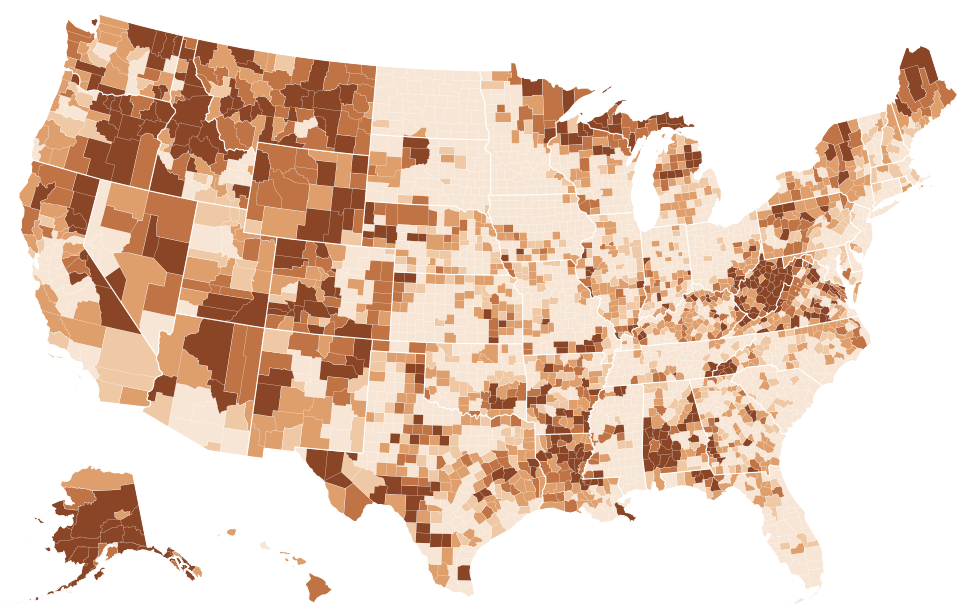
Source: FCC, National Broadband Map, data as of June 30, 2026; Census Bureau, Cartographic boundary file cb_2025_us_county_5m. FCC file revision of November 10, 2026. Shares are of broadband serviceable locations (homes and businesses), not people. The table lists the 25 highest and 25 lowest counties; every county is in the downloads.
Show the numbers
| County | Satellite only |
|---|---|
| Yakutat City and Borough, Alaska | 100.0% |
| Kalawao County, Hawaii | 56.6% |
| Wheeler County, Oregon | 44.9% |
| Southeast Fairbanks Census Area, Alaska | 41.9% |
| Carter County, Missouri | 40.3% |
| Garfield County, Montana | 36.8% |
| Keweenaw County, Michigan | 35.6% |
| Yukon-Koyukuk Census Area, Alaska | 35.1% |
| Calhoun County, West Virginia | 34.8% |
| Catron County, New Mexico | 34.6% |
| Alpine County, California | 34.0% |
| Boise County, Idaho | 33.9% |
| Rappahannock County, Virginia | 33.5% |
| Perry County, Alabama | 33.2% |
| Sumter County, Alabama | 32.6% |
| Petroleum County, Montana | 32.6% |
| Lake and Peninsula Borough, Alaska | 32.0% |
| Sioux County, Nebraska | 31.4% |
| Braxton County, West Virginia | 31.4% |
| Forest County, Pennsylvania | 30.4% |
| Prince of Wales-Hyder Census Area, Alaska | 28.5% |
| East Feliciana Parish, Louisiana | 27.7% |
| Trinity County, California | 27.6% |
| St. Helena Parish, Louisiana | 27.5% |
| Graham County, North Carolina | 26.9% |
| Bailey County, Texas | 0.0% |
| Glasscock County, Texas | 0.0% |
| Hardeman County, Texas | 0.0% |
| Lynn County, Texas | 0.0% |
| Parmer County, Texas | 0.0% |
| Terry County, Texas | 0.0% |
| Wichita County, Texas | 0.0% |
| Alexandria city, Virginia | 0.0% |
| Bristol city, Virginia | 0.0% |
| Emporia city, Virginia | 0.0% |
| Fairfax city, Virginia | 0.0% |
| Falls Church city, Virginia | 0.0% |
| Lexington city, Virginia | 0.0% |
| Manassas city, Virginia | 0.0% |
| Norton city, Virginia | 0.0% |
| Winchester city, Virginia | 0.0% |
| Marion County, Alabama | 0.0% |
| Greene County, Arkansas | 0.0% |
| Sacramento County, California | 0.0% |
| San Francisco County, California | 0.0% |
| Sutter County, California | 0.0% |
| Broomfield County, Colorado | 0.0% |
| Denver County, Colorado | 0.0% |
| Phillips County, Colorado | 0.0% |
| Greater Bridgeport Planning Region, Connecticut | 0.0% |
County shares run much higher than state shares. In Alaska, Yakutat City and Borough has satellite as the only option at 100.0% of its locations; in West Virginia, Calhoun County reaches 34.8%1. In counties like these, a HughesNet listing sits next to the other satellite providers and nothing else.
Change since 2022: following the FCC's location list
HughesNet's reported footprint grew by 3,479,3223 locations between June 30, 2022 and June 30, 2026. Over the same period the FCC's national list of locations grew by 3,495,329. Since December 31, 2025, the two changes are almost identical: +580,8666 for HughesNet against +581,0491 for the list.
For a provider that already reports nearly every location, a rising count mostly reflects new and corrected entries in the FCC's list rather than new reach. Alaska shows it clearly: the FCC's Alaska list grew by 68,484 locations since June 2022, and HughesNet's Alaska count in the table below rose by a similar amount. Where HughesNet's count fell, the list shrank too: Kentucky's list changed by −41,180 locations and Iowa's by −16,9711.
State by state
Every state where HughesNet reports service, with its locations, its share of the state, the change since the first National Broadband Map of June 30, 2022, and its fastest advertised download.
| Texas | 10,399,200 | 100.0% | Satellite | 0 | +614,215 | 100 Mbps |
|---|---|---|---|---|---|---|
| California | 10,289,123 | 100.0% | Satellite | 0 | +304,423 | 100 Mbps |
| Florida | 7,744,197 | 100.0% | Satellite | 0 | +576,454 | 100 Mbps |
| Pennsylvania | 4,883,624 | 100.0% | Satellite | 0 | +33,255 | 100 Mbps |
| New York | 4,703,264 | 100.0% | Satellite | 0 | +32,888 | 100 Mbps |
| Ohio | 4,547,998 | 100.0% | Satellite | 0 | +69,803 | 100 Mbps |
| North Carolina | 4,435,320 | 100.0% | Satellite | 0 | +222,820 | 100 Mbps |
| Illinois | 4,125,022 | 100.0% | Satellite | 0 | −6,405 | 100 Mbps |
| Michigan | 4,008,239 | 100.0% | Satellite | 0 | −19,527 | 100 Mbps |
| Georgia | 3,887,764 | 100.0% | Satellite | 0 | +194,319 | 100 Mbps |
| Virginia | 2,923,117 | 100.0% | Satellite | 0 | +82,844 | 100 Mbps |
| Tennessee | 2,793,463 | 100.0% | Satellite | 0 | +107,060 | 100 Mbps |
| Arizona | 2,787,690 | 100.0% | Satellite | 0 | +215,130 | 100 Mbps |
| Indiana | 2,718,718 | 100.0% | Satellite | 0 | +269 | 100 Mbps |
| New Jersey | 2,587,473 | 100.0% | Satellite | 0 | +52,760 | 100 Mbps |
| Washington | 2,577,578 | 100.0% | Satellite | 0 | +70,990 | 50 Mbps |
| Missouri | 2,518,864 | 100.0% | Satellite | 0 | +31,938 | 100 Mbps |
| Wisconsin | 2,306,523 | 100.0% | Satellite | 0 | +22,736 | 100 Mbps |
| South Carolina | 2,253,575 | 100.0% | Satellite | 0 | +146,140 | 100 Mbps |
| Alabama | 2,206,378 | 100.0% | Satellite | 0 | +66,530 | 100 Mbps |
| Minnesota | 2,127,353 | 100.0% | Satellite | 0 | +47,498 | 100 Mbps |
| Colorado | 1,999,898 | 100.0% | Satellite | 0 | +94,021 | 100 Mbps |
| Massachusetts | 1,966,692 | 100.0% | Satellite | 0 | +44,871 | 100 Mbps |
| Louisiana | 1,868,435 | 100.0% | Satellite | 0 | +13,190 | 100 Mbps |
| Maryland | 1,864,600 | 100.0% | Satellite | 0 | +52,789 | 100 Mbps |
| Kentucky | 1,843,482 | 100.0% | Satellite | 0 | −41,181 | 100 Mbps |
| Oklahoma | 1,742,265 | 100.0% | Satellite | 0 | +55,729 | 100 Mbps |
| Oregon | 1,521,337 | 100.0% | Satellite | 0 | +36,679 | 100 Mbps |
| Iowa | 1,365,027 | 100.0% | Satellite | 0 | −16,972 | 100 Mbps |
| Arkansas | 1,361,810 | 100.0% | Satellite | 0 | −17,936 | 100 Mbps |
| Mississippi | 1,325,972 | 100.0% | Satellite | 0 | +24,622 | 100 Mbps |
| Kansas | 1,194,103 | 100.0% | Satellite | 0 | −7,798 | 100 Mbps |
| Connecticut | 1,092,925 | 100.0% | Satellite | 0 | +16,864 | 100 Mbps |
| Utah | 1,048,011 | 100.0% | Satellite | 0 | +73,852 | 100 Mbps |
| Nevada | 1,027,755 | 100.0% | Satellite | 0 | +71,156 | 100 Mbps |
| West Virginia | 897,522 | 100.0% | Satellite | 0 | +229 | 100 Mbps |
| New Mexico | 860,254 | 100.0% | Satellite | 0 | +28,038 | 100 Mbps |
| Nebraska | 794,388 | 100.0% | Satellite | 0 | −4,894 | 100 Mbps |
| Idaho | 773,478 | 100.0% | Satellite | 0 | +61,159 | 100 Mbps |
| Maine | 645,797 | 100.0% | Satellite | 0 | −9,020 | 100 Mbps |
| New Hampshire | 520,702 | 100.0% | Satellite | 0 | +16,997 | 100 Mbps |
| Montana | 498,334 | 100.0% | Satellite | 0 | +15,254 | 100 Mbps |
| Delaware | 410,284 | 100.0% | Satellite | 0 | +24,748 | 100 Mbps |
| South Dakota | 393,489 | 100.0% | Satellite | 0 | +907 | 100 Mbps |
| Rhode Island | 343,860 | 100.0% | Satellite | 0 | +8,194 | 100 Mbps |
| North Dakota | 327,405 | 100.0% | Satellite | 0 | −13,488 | 100 Mbps |
| Alaska | 282,915 | 100.0% | Satellite | 0 | +69,105 | 25 Mbps |
| Vermont | 282,758 | 100.0% | Satellite | 0 | +10,812 | 100 Mbps |
| Wyoming | 262,480 | 100.0% | Satellite | 0 | +2,312 | 100 Mbps |
| District of Columbia | 123,145 | 100.0% | Satellite | 0 | +2,943 | 50 Mbps |
Source: FCC, National Broadband Map, data as of June 30, 2026; FCC, National Broadband Map, data as of June 30, 2022. Broadband serviceable locations where HughesNet reports service as of June 30, 2026, compared with June 30, 2022. The FCC location list changes between releases, so part of a change can come from added or corrected locations.
Its largest states by location count are simply the largest states: Texas (10,399,200), California (10,289,123) and Florida (7,744,1971). Because the share is the same almost everywhere, the order of the table says more about how many locations each state has than about HughesNet.
Why city provider tables leave HughesNet out
HughesNet reports service across every large city outside Hawaii, so a list of cities ranked by its share would show the same figure from top to bottom. City and state provider tables on this site list terrestrial providers and set satellite aside, because a nationwide satellite listing says nothing about the choice of wires on a street. To see whether a cable, fiber or fixed wireless network is reported at an address, use the FCC map; to compare technologies nationally, see fiber, Starlink and Viasat.
HughesNet availability questions
Is HughesNet available in my area?
Almost certainly, unless you live in Hawaii. HughesNet reports service at 115,463,606 of the 115,784,9151 US locations in the FCC data as of June 30, 2026. Satellite service also needs equipment installed at the home, so confirm with HughesNet, and check what else is reported at your address on the FCC National Broadband Map.
Is HughesNet available in Hawaii?
Not according to its FCC filing: HughesNet reports no locations in Hawaii, which has 320,647 homes and businesses in the FCC data. Starlink reports 100.0% of Hawaii's locations and Viasat 99.9%1.
How fast is HughesNet according to the FCC data?
HughesNet's fastest advertised speed in its FCC filing is 100 Mbps download and 5 Mbps upload. In Alaska its fastest advertised download is 25 Mbps, and in Washington and DC 50 Mbps. These are advertised maximums, not measured speeds.
Does HughesNet count as broadband?
Not on the 100/20 Mbps measure this site uses: HughesNet reports 01 locations at 100/20 or more. Under the BEAD program's definitions a location with only satellite service is unserved (see our methodology).
How much does HughesNet cost?
The FCC availability data contain no prices. HughesNet, like every home internet provider, has to publish a broadband facts label with its monthly price, fees and speeds for each plan.
Is HughesNet available at your address?
Area figures cannot answer that. Search the address on the FCC's National Broadband Map, which lists every provider that reports service there, and confirm with HughesNet before you sign up. If the map shows HughesNet but it cannot connect you within ten business days, you can challenge the listing on the map.
Sources
- FCC, National Broadband Map, data as of June 30, 2026; Availability as of June 30, 2026; released November 10, 2026. broadbandmap.fcc.gov
- Census Bureau, Cartographic boundary file cb_2025_us_state_20m. www2.census.gov
- FCC, National Broadband Map, data as of June 30, 2022; Availability as of June 30, 2022; released May 10, 2024. broadbandmap.fcc.gov
- Census Bureau, American Community Survey 2025 1-year detailed tables; 2025 (calendar-year sample); released October 29, 2026. api.census.gov
- Census Bureau, Cartographic boundary file cb_2025_us_county_5m. www2.census.gov
- FCC, National Broadband Map, data as of December 31, 2025; Availability as of December 31, 2025; released November 3, 2026. broadbandmap.fcc.gov
Margins of error (±) are at the 90% confidence level. A difference is called significant only when it passes the Census Bureau's test at that level. How every figure is built: methodology. Found an error? Write to [email protected]; corrections are listed on the updates page.